
By Michaela Roper
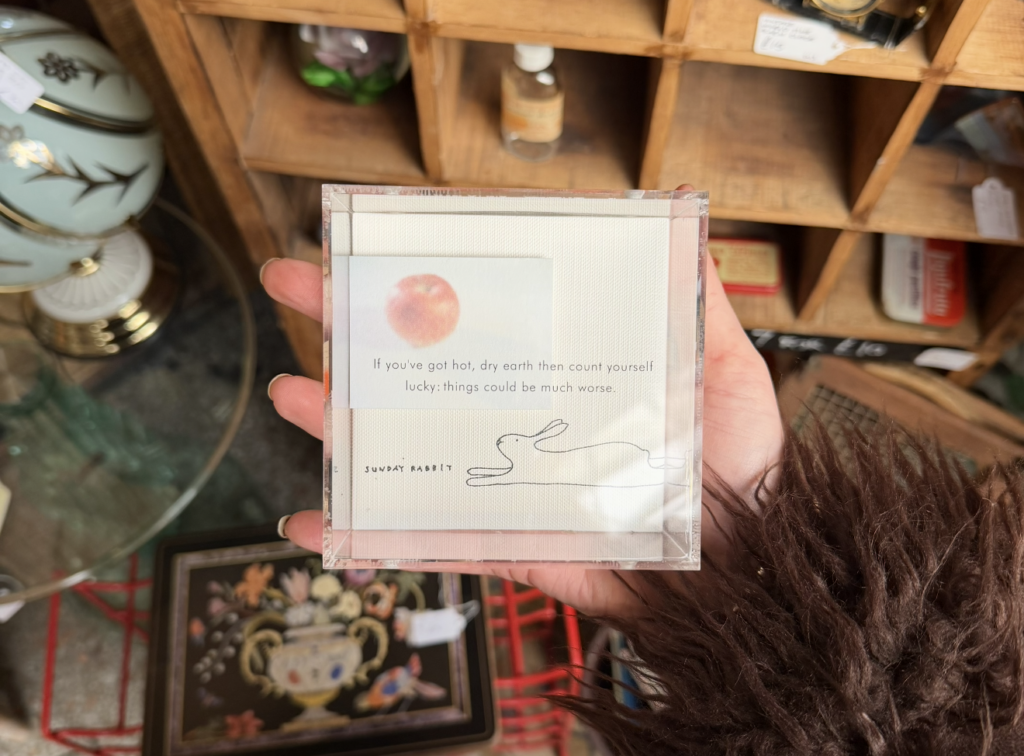
It was, in fact, a Sunday afternoon when I first encountered the Sunday Rabbit. A peculiar thing, of wobbly lines, set within a shadow box but appearing as free as ever. A gaze fixed upon the polished red skin of a braeburn, or lady in pink, or simply just a stock image of a slightly fuzzy red apple, reminiscent of primary school lunchtimes and sandwich bags.
The Sunday Rabbit sat alongside a rusting tin of cough sweets, and was neighboured by a navy blue box which seemed pleased to house the dusty remains of a cube of toffee. Below it, an unsettling goblin-like creature occupied a glass paperweight bearing a design unexpectedly dedicated to the old Nottingham Evening Post. It was the Sunday Rabbit that occupied a space 143 miles away from the press’ headquarters that drew me in.
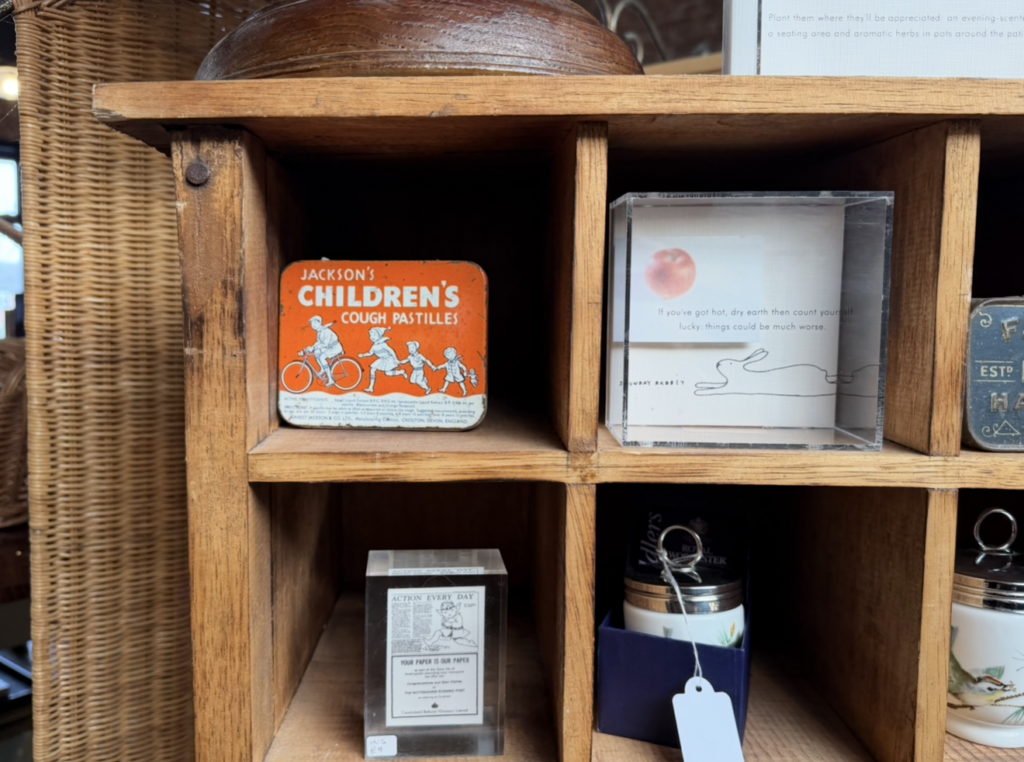
The fringed tails of my coat brushed along chair legs, across the face of a magazine rack, and around a curated selection of antique militaria that smelt vaguely of shed doors and woolen jumpers. The items were sprawled across the crumbling wooden floors of an old Edwardian Co-Operative Bank, turned treasure trove, in the North East – an eccentric meeting place for old curious souls.
The Sunday Rabbit once belonged to Rari Yoshio, a Tokyo-born artist who, since childhood, has clung to the whispers of the trees and observed the gentle mechanics of nature to produce thought-provoking installations and physical art pieces, focused on the quiet aspects of everyday life.
There is a timelessness to her work; a soft touch, simplistic composition, and quiet delicateness embedded within curved lines and language inspired by the regeneration of seeds on the forest floor. Rari Yoshio began her career as a handbag designer, and in 2001, answered Mother Nature’s calls to depict her beauty through illustration and design.
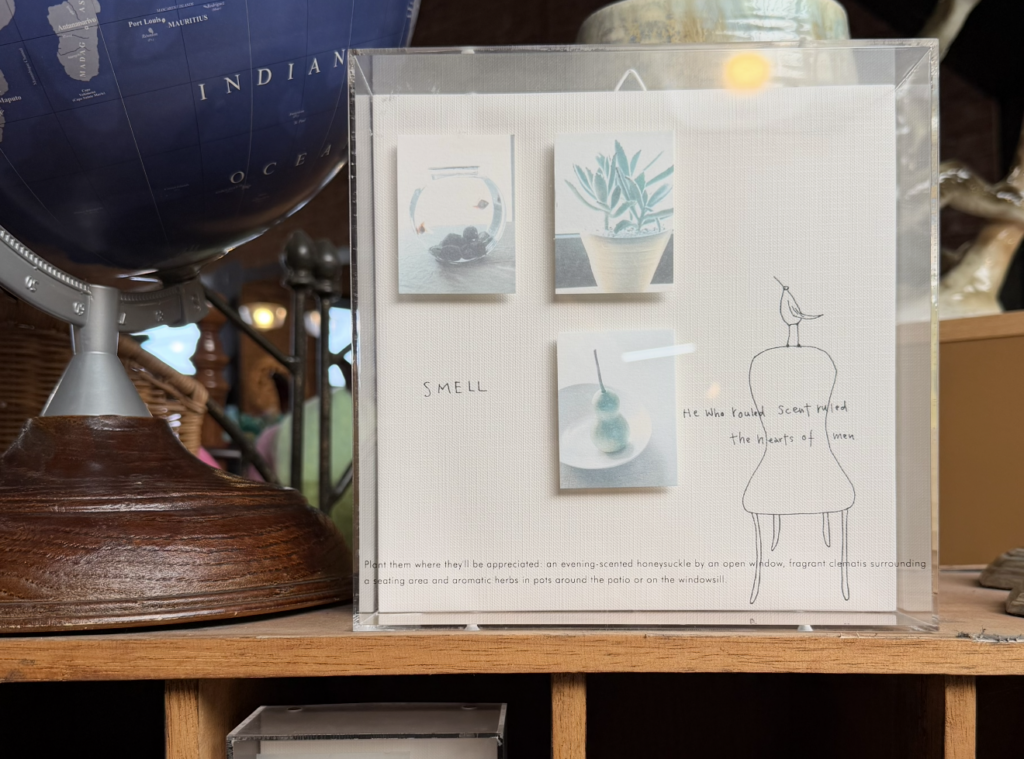
Above the Sunday Rabbit stood a similar piece, a dedication to the scent of salt water, herbaceous perennials, and fragrant memories of love. Smell was bigger, with more to say, depicting a fishbowl and houseplant alongside a romantic verse undoubtedly written on a balcony under the breeze of a warm summer evening. A deeper dive into Rari Yoshio’s portfolio uncovers her botanical fragrance workshops – an interactive insight into her strengthening relationship between nature’s scented hues and her approach to her artwork.
The hand-scrawled quote from Patrick Süskind’s famous 1985 novel Perfume: The Story of a Murderer reads “he who ruled scent ruled the hearts of men”. The arcane minimalism of the display’s composition, and contrast between an image of a gourd-like vegetable and the verbal depiction of one’s relationship with scent, places a unique view of nature at the centre of her work.
The Sunday Rabbit – otherwise known as Rabbit +1 (2001) – now belongs to me, the 705th piece out of 800, signed by Rari Yoshio herself, I think.
In 2005, she published a book of the same name, a collection of tales, essays, and photographs inspired by her own leporidae accompaniments over the years. Yet the acrylic box in which the rabbit appears feels like a personal exhibition – as if she has framed this apple and wobbling sketch just for me, a prism in which time and space makes room for an insightful line of thinking on luckiness and sandy steps along the earth.
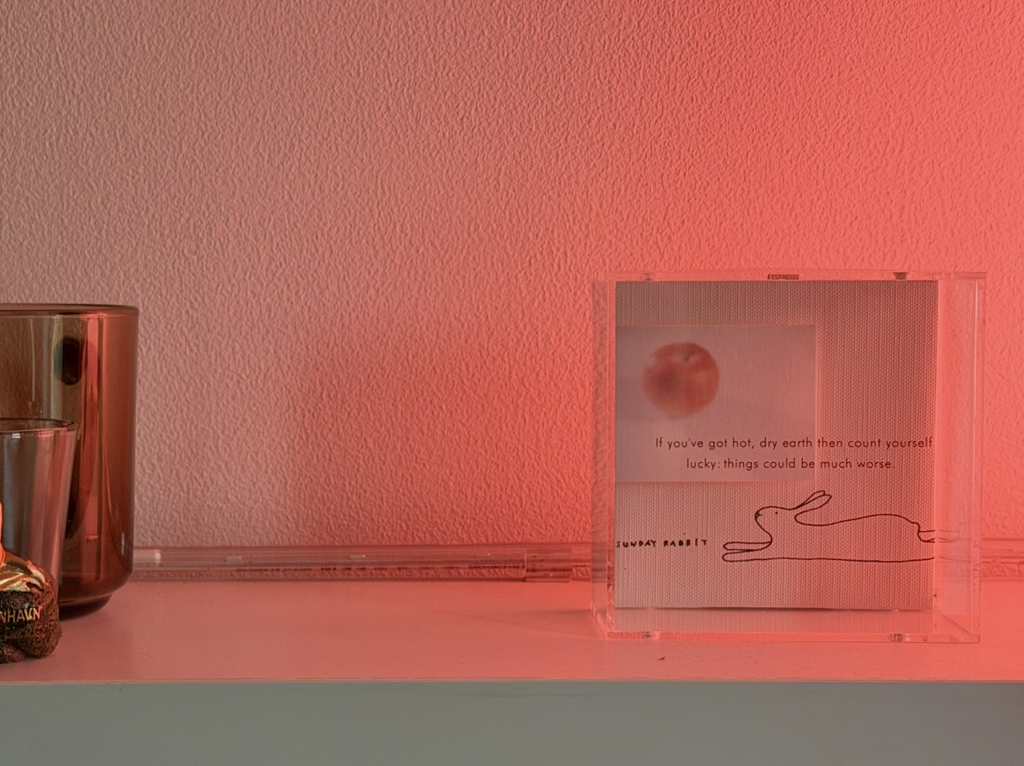
Maybe there’s a weird irony in the notion of the ‘hot, dry earth’ now. I suppose in 2001, the earth’s strain under climate change wasn’t quite in Rari Yoshio’s artistic vision, but nevertheless, is an interesting snippet of speech to frame alongside the photographed apple. It almost echoes the language of a Margaret Atwood piece for Medium Magazine, in which she details our planet, its fertility, and soil, as taken for granted, and as “neither too hot or too cold, neither too wet or too dry”.
Or maybe, Yoshio was aware of it all along.
Still, there is something that draws me in about the Sunday Rabbit – potentially its artistic similarity to the work of David Shrigley, or the idea of an acrylic exhibition curated just for me, sitting on a shelf in my bedroom a mere 8,678 miles away from its place of origin.
This notion of space, time, and scent draws upon the Japanese wisdom of wabi-sabi (わびさび) – two interrelated aesthetic concepts in local culture with origins in art, literature, and religion. In Japanese, as detailed by author Beth Kempton, Wabi is about finding beauty in simplicity, and a spiritual richness and serenity in detaching from the material world. Sabi is more concerned with the passage of time, with the way that all things grow and decay and how ageing alters the visual nature of those things.
To connect this practice to Rari Yoshio’s work is to celebrate the sometimes flawed yet gently decaying beauty within nature – its wobbling lines, out-of-focus imagery, and unusual presentation, all drawing from Mother Nature’s influence to provide aesthetic serenity and commentary on time’s slow passing.
And to encounter the Sunday Rabbit in an emporium of objects preserved within the passing of time, a living museum dedicated to storytelling, feels like an apt tribute to the serene traditions of wabi-sabi as we quietly meandered down rivers of memorabilia. The dust kicked up from vintage rugs settled upon the frames of retro mirrors, advertising boards, and silver plated trinket boxes – pieces weathered by time’s passing and nature’s influence, now in the hands of storytellers and serenity-seekers.
Rari Yoshio’s mixed media acrylic displays, alongside her work at exhibition Jardin Blanc, promise an interesting dichotomy between nature and material, both attached and detached, in search of the notion of wabi – which draw you in with an unusual sense of connection, even to a blurry image of an apple and its shadow.
Leave a Reply