
In Review: King Lear at The Crucible, 2026
By Sam Horsfield
A muted hubbub of anticipation was flowering within the crowd, as we sat before the dimmed thrust stage of the Crucible theatre. Directed by Titas Halder, Sheffield Theatre’s King Lear was due to start in ten-minutes. With Ian McDiarmid of Star Wars fame donning the role of the king, the crowd eagerly awaited the stormy play, overlooking the stone-coloured stage, which sat bare, simple, and silent.
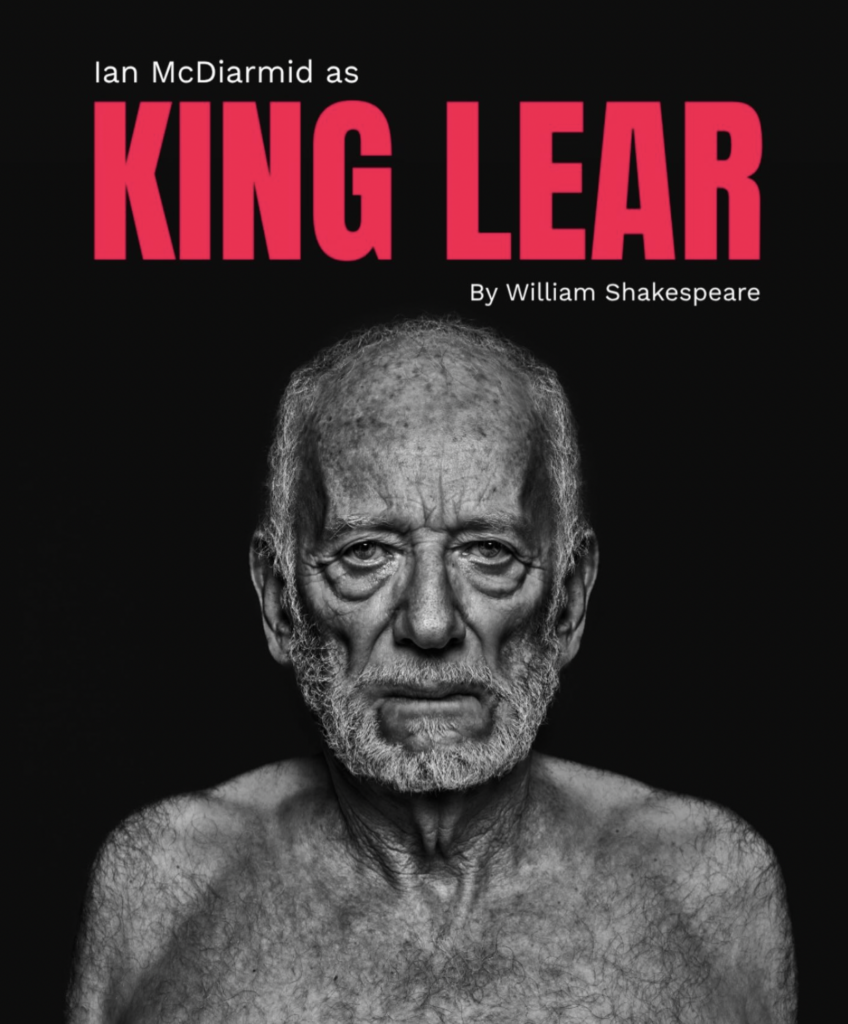
Outside, a storm of our own had begun to take Sheffield. A late Summer spitting had rendered the skies grey, and the pavements wet, almost a premonition of the tempest to come. Tonight was the production’s first preview night, and thus many damp onlookers looked forward to viewing the first public showing of the Shakespearean classic.
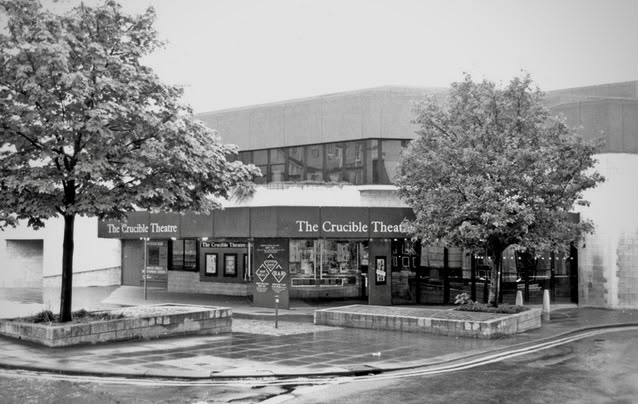
The Crucible’s first opening in 1969, Sheffield
Halder’s King Lear retells one of Shakespeare’s most mature works. McDiarmid’s King, old and withering, renunciates his rulership, offering his land to be divided between his three daughters, upon a satisfactory declaration of love from each of them. The daughters Goneril and Regan, played by Katie Wimpenny and Justina Kehinde, eager for power, offer fabricated exclamations, fawning and complimentary. Their love appears false, mere flattery in return for a cut of the crown.
Lear’s favourite daughter, Bebe Sanders’ Cordelia, sees through her sisters’ lies, and refuses to participate, resulting in her banishment.
Seizing power, the remaining sisters cease to treat Lear as king, and he grows insane, in only the company of his fool, and a madman. A storm begins to rage, almost an echo of Lear’s developing derision, until Cordelia returns with French forces in an attempt to rescue her father.
The French forces lose, and Cordelia is hanged.
Goneril poisons Regan in a dispute for power, but kills herself, consumed by guilt. Lear dies of a broken heart, symbolised in Halder’s production by the placement of a noose around his neck by the silent spirit of the hanged fool. In what seems a never ending storm, all die.
McDiarmid’s performance is exemplary. His whittling prose, oscillating between quiet chattering and deranged ranting, was convincing of a king’s descent into madness.
His gradual waddling and stumbling around the stage, while the rest stood still and silent, fearful amidst the king’s raves, show McDiarmid’s ability to be an ominous presence. There is certainly an Imperial essence to the way in which he commanded his compatriots, but this dissipates with the storm. Before long, Lear is simply a senile old man, his intimidation dwelling not from his power, but his unpredictability. He appears not as a king, often crawling on the floor, his trousers, at one point, at his ankles. He appears, at times, as much a fool as his fool.
McDiarmid’s ability to characterise both regal aura and a doddering instability is a testament to his veteran status.
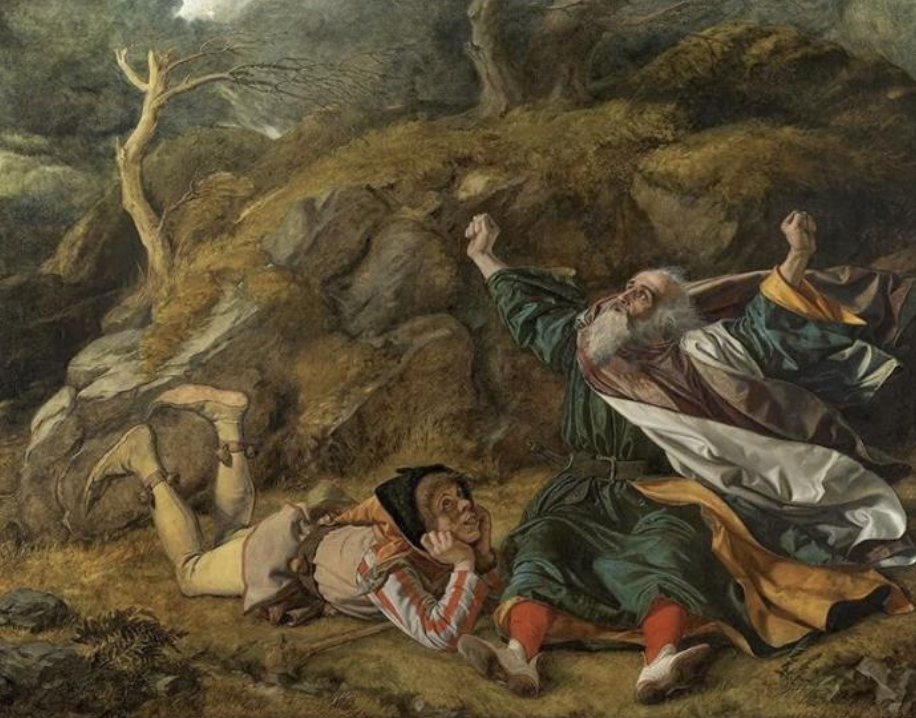
King Lear and the Fool in the Storm by William Duce. Circa 1851, oil on canvas, National Galleries of Scotland, Edinburgh.
The painting depicts the exact moment King Lear descends into madness during Act 3, Scene 2 of Shakespeare’s tragedy.
Max Revell’s character of the fool is another performance highlight. His experience as a dancer grants an impressive degree of physicality to his movements. Particularly during the most vicious throws of the storm, Revell’s movements seem to defy the laws of physics, as he rolls and crawls on the floor as though battling a real wind. Even in quieter moments of conversation, his movement, bounding and exaggerated, makes him stand out, capturing the crowd.
Originally written in the early years of the 1600s, King Lear is a product of its time. Its symbolisms and reflections capture the sense of end-times that seemed rampant in its era.
From the tragic deaths of all lead characters, to more minor details, such as the repetition of the simple word “nothing”, King Lear’s nihilistic qualities give it more in common with modernist texts than other Jacobean dramas. The mythology of Lear places it in an absurd and meaningless world, defined by its insanity. It takes place in a time before Christ, banishing the hope of a happy ending to its early modern crowd; there is no single ‘other’, no single character or being that is able to fix the mess.
The Pagan Gods are referred to throughout, but never with a tongue of hope. The demise of all is almost a necessity, as much as it is a response to the feared Revelation that is always spurred by time’s movement and society’s progression. While ever the clock ticks, time is on its way to end. There is no surprise, then, that King Lear translates so well to a modern day audience.
Halder’s production blends the modern and the traditional. The first scene sees the King in regal attire, a white cape flowing at his feet. But later in the play, he dons a worn, black leather trench coat. Worn leather seems to be a theme of the play’s dress, sported by multiple characters, adding a sort of post-apocalyptic visual aesthetic that contributes to the theme of end-times.
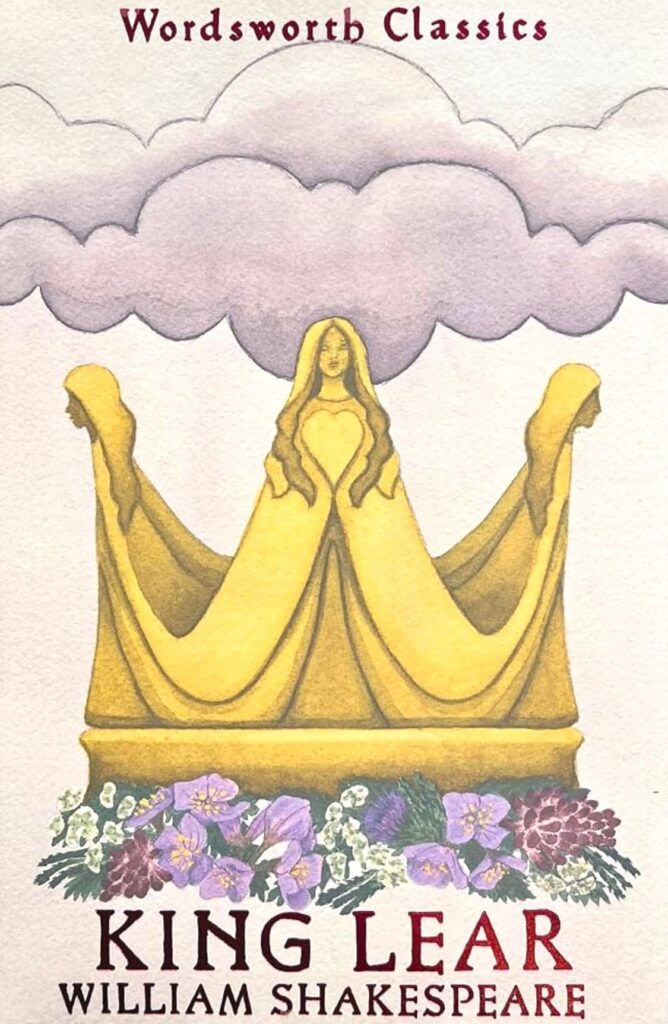
William Shakespeare (1994) King Lear. Edited by C. Watts. Ware: Wordsworth Editions.
Similarly, the stage decor is almost brutalist. The stage and the back wall are a stone grey, quietly minimalist but loud in its eeriness. Throughout the play, one can hear a persistent, unsettling drone, sometimes decorated by percussive stabs. Its unnerving, like a foreboding of the doom to come. A fog hovers above the stage, which grows denser as the play goes on, as a result of the storm. Halder paints Shakespeare’s prehistoric England as almost dystopian, the striking modern appearance contrasting the traditional speech. The play leans into the nihilism in aesthetic as much as narrative, creating a whole picture in which growing mania and inevitable fatality seem destined. There is no beauty in this England. It is throned by menace.
Tolstoy once criticised what he saw as a sort of hysteric flocking of praise for Shakespeare, born from 19th Century academia rather than any true historic merit. In one essay, he singled out King Lear as the epitome of this argument. He criticised the play, claiming it was not, as great art should be, “important to the life of mankind”.
George Orwell responded in an essay of his own, titled Lear, Tolstoy, and the Fool in which he criticised Tolstoy’s argument, and offered what he saw as proof of King Lear’s importance. “There is no test of literary merit except survival”, said Orwell, and though both writers’ arguments are flawed in some way or other, the question must be asked: why has King Lear survived as it has? What is it about the play that makes it applicable to all eras?
The political atmosphere of any era in time is often defined by its turbulence. The tale of a mad monarch, demanding and whining, babyish and untrustworthy, is all too reminiscent of certain world leaders in the public eye today. Meanwhile, wars in which morals are muted are waged all over the global stage. And, at the heart of it all, summoned from all this mess, a storm seems to constantly rage.
In a Godless world, there seems little in the way of hope these days. Perhaps we have more in common with King Lear today than ever before.
Leave a Reply