
By Sam Horsfield
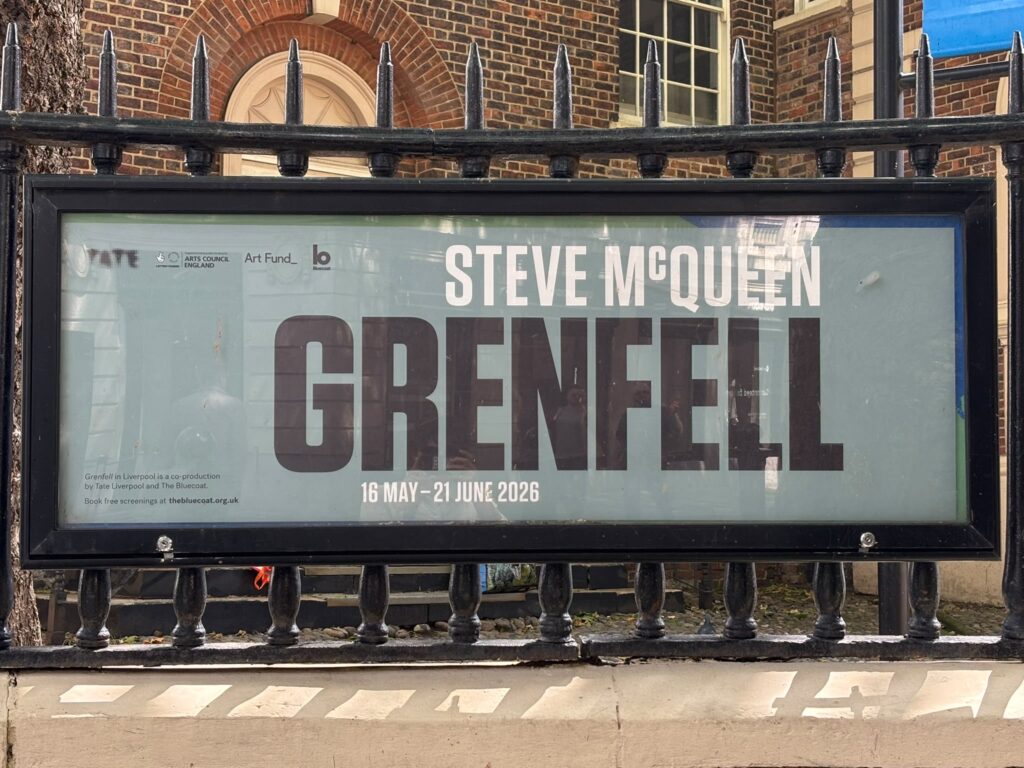
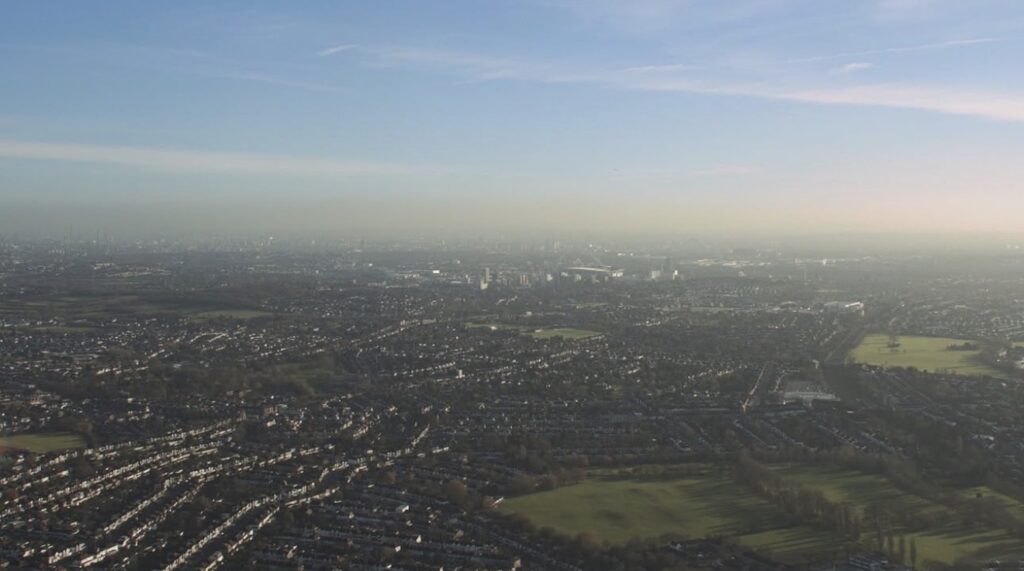
Steve McQueen’s ‘Grenfell’ begins from above, sailing the audience through the air over green pastures, intermittently passing congregations of suburban houses. The sky is blue and the scene is pretty, a stark contrast to what is to come. In the background, there is the noise of wind, accompanied by the odd murmur of the towns below. It is an unsettling hum, but nothing – for the moment – too unnatural. A few minutes pass, and we are still soaring. The rolling fields are increasingly replaced by more houses, civilisation gradually encroaching on what was once nature. The volume rises, and we swerve slightly, the horizon revealing taller, more dominating buildings. From a distance, the city of London grows closer and closer, and the urban thrum becomes almost cacophonous, with police sirens and blaring car horns joining the din as we fly over Wembley.
It isn’t long before we see Grenfell Tower. At first, it seems nothing out of the ordinary, an albeit darker tower standing tall over Notting Hill. The drone upon which we soar locks onto the building, holding it in centre frame, and as we near it the dissonance gradually diminishes. This isn’t the relief it seems to be, however, as, with each closing metre, each scorch mark and scar becomes clearer and clearer. The audial hubbub mutes to a silence, uncomfortable and eery.
Void of sound, the ruins speak volumes.
The unnerving hush feels heavy as the camera begins laps of Grenfell Tower, starting from afar but gradually closing in. The once white and grey outer walls of the apartment block are scorched a charry black, pale orange wounds resembling flickering embers sometimes marking the fossilised cladding. Not a single window remains, and as the drone veers closer, devastation filling the screen from corner to corner, we can peer into what were once homes, now empty and burnt.
It feels dystopian, unreal, post-apocalyptic rubble more suited for a horror film than reality, and yet Steve McQueen’s work is documentary, not fiction. The closer we get, the more we can make out forensic workers dressed in all white almost spacesuits, working from the inside as Grenfell is dismantled, irreparable after disaster. The drone is still spinning, circling the tower endlessly, and I found myself almost dizzy, an overwhelming queasiness gripping my throat as I watched, unable to avert my attention.
The first time the drone pulled away, I hoped the sound would return. I missed the London racket, or at least I missed the safety and society it grounded me in. But the absence continued. The silence remains as deafening as before; these had been people’s homes, lost in a single night. That type of silencing – the silencing of lives – doesn’t disappear with distance.
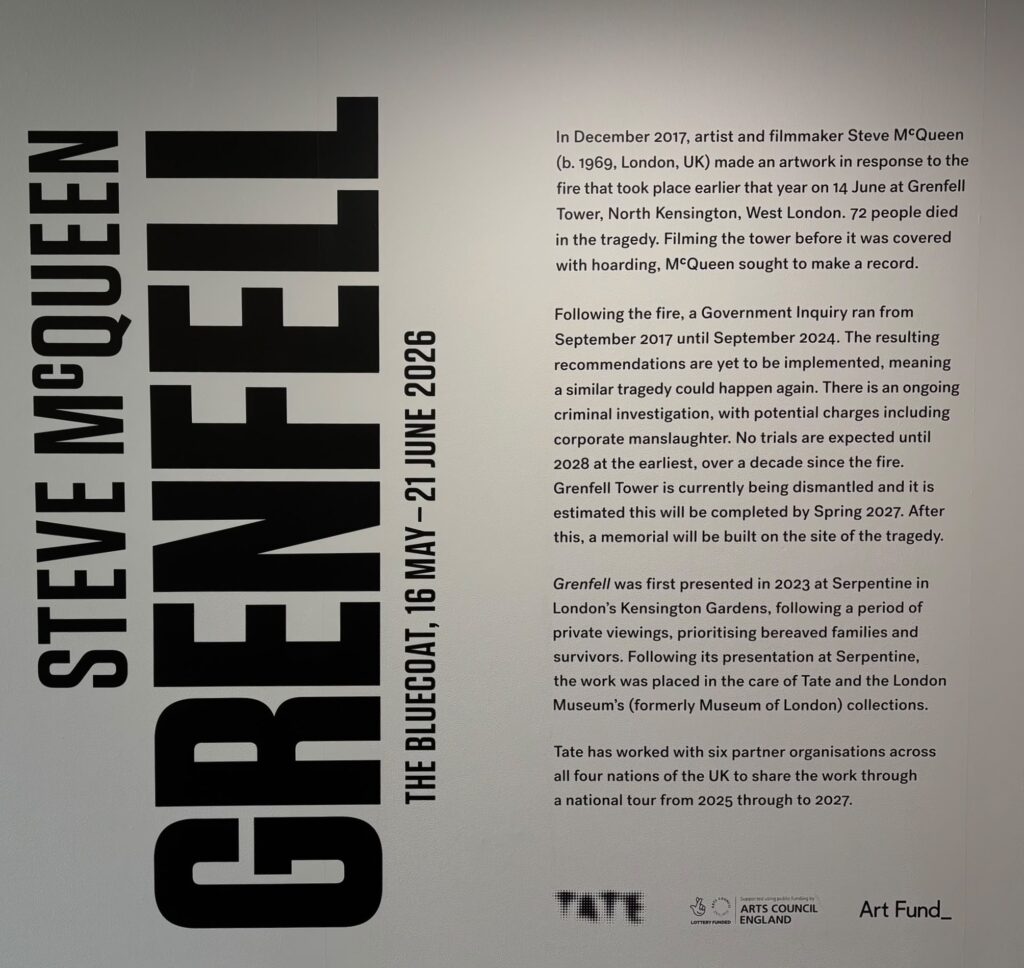
After a brief return to a close-up, the camera pulls away for a final time and the din returns. The world forgets. Time passes, and people move on. Nearly a decade after the disaster, no trials are expected for what has been suspected causal misconduct until 2028 – an obscene eleven-year lacuna of justice-less waiting, despite the loss of seventy-two lives.
“It was not an accident”, states Paul Gilroy, writing his segment in the piece’s accompanying pamphlet. An almost expected and forewarned disaster, Gilroy blames a “colonial” capitalistic machine which breeds off corruption and greed for the turning of a blind eye to noted safety-risks. This puts the beginning of the film into perspective, green fields and small collections of housing almost overshadowed by the ominous giant of modernity which is inner London. Likening the flames of Grenfell to the crushes of Hillsborough, Gilroy questions “Whose lives matter?” as attempts to investigate the causes of such disasters are “shrouded in mists of calculated misinformation.”
I wish I could quote Gilroy’s entire letter on the matter, as he singlehandedly calls out governmental foul play and their inability to provide any just emotional, physical, or legal requiem for the lives lost at Grenfell in 2017. He notes the inability of any art to make right the horrific injustices McQueen’s film displays firsthand, but praises what he sees as McQueen’s confrontation of both the structure itself, once a home to many, as well as a confrontation of the meaning we must take from the disaster itself – that this cannot be allowed to happen again.
Between 2014 and 2016 refurbishments on Grenfell Tower replaced the outer walls’ cladding with polyethylene-based Aluminium Composite Material (ACM) – likened to “solid petrol”. Representing the bereaved, Danny Friedman stated that the refurbishments were “obviously dangerous, reprehensible and contrary to regulations”. For twelve years before the disaster, the material consistently failed fire safety tests, but the British Board of Agrement were never properly informed. And thus, the material was used, alongside Celotex RS5000 insulation, which only passed fire tests itself due to the use of extra fire- retardants and non-combustible panels. It was later discovered that upon burning, this type of insulation releases toxic fumes including cyanide. Why, then, were such clearly unsafe materials used? The answer to that is simple: they are cheap. ACM is known for its cost-effectivity, and RS5000 is often sold discounted.
Seventy-two lives lost all so a company riddled with corruption could save money.
Filmed in 2017, but not shared with the public until 2023, McQueen recalled that he felt a need to make the film due to the pain he and many others felt on account of the disaster being the result of “deliberate neglect”. McQueen recalled memories of he and his father’s friends who lived in and around Grenfell Tower, a diverse community of all backgrounds full of an energetic buzz, silenced in a single night.
Upon finishing the short documentary, the other viewers and I were led out of the screening room of Liverpool’s Bluecoat, where the exhibition is currently being shown. We were led into a room of all white, an almost visual reflection of the opaque silence we had just drowned in, and now carried sombrely with us. On the far wall, in black text, read the names of the seventy-two Grenfell residents who had lost their lives.
As I read each name, I was struck by how many shared the same surname. Families. Entire families lost to a preventable obscenity, allowed to happen by greed.
As I left The Bluecoat, Liverpool’s sky was grey, taunting bitter rain. I realised then and there that no matter how many heatwaves came this Summer or next, how many times the sun decided to shine, our country’s sky would remain grey, a miserable and overcast injustice generated by an unbothered government, and unbothered corporations, hanging over us until change is achieved.
Steve McQueen remembers those dead, injured, or bereaved as a result of the fire, and I suggest we remember with him. We cannot forget as so many have.
Leave a Reply