
by Sam Horsfield
A five-piece jazz band crams in a sweaty New York subway station, playing to a different audience every ten seconds. Nobody is truly listening as they half-walk-half-jog to their platform, or natter to one another about the quickest route, or bicker about the weather or some other day-to-day matter that keeps eyes glued elsewhere. Despite such a nonaudience, the five-piece play. A golden saxophone whines passionately to the deep chugging of a tuba. The trumpet screeches a countermelody alongside a trombone’s chromatic cries, all kept to some danceable tempo thrashed out by a drum kit. They are fit for a stage, and yet here they are, in the corner of someplace they don’t belong, golden brass glistening.
Their music travels through the air – not through headphones, or speakers, or a crackly car radio. A thousand years before, a poet sang of the heroic struggles of Achilles and Agamemnon, to the twinkling strings of a lyre. Hundreds of years passed, and a troubadour arrived at the doors of that night’s court, where he would play the lute until the morning, before strapping on his boots and trudging to the next town. Later, a cowboy flopped by a campfire, removing his hat, and then strumming a few chords to none but the dusk. ‘Busking’ comes from the Spanish buscar – to ‘seek’; to seek an audience where there lacks a stage, and to make one of concrete. Before celebrities, and thousand-capacity venues, before record labels and nifty technology, there was but sound and ears, traversing airwaves straight from the artist’s soul.
The art of busking still exists to this day. Albeit limited by hundreds of years of developing regulations and licensing agreements since the 1500s, one can still walk through the urban forest of a city and be struck by live music in some form or other. These regulations began in 1530, when Henry VIII imposed license requirements on minstrels to ensure they were not vagrant wanderers of the undesirable sort, “or else be set in the stocks”. This ‘Vagabonds Act’ was rewritten throughout the latter half of the millennia, but more or less retained the same restrictions for wandering musicians. By the Victorian era, an emergent middle-class, increasingly more able to work from home, found street performers to be a nuisance, leading to the Street Music Act of 1864, allowing such businessmen to order performers to vacate, or else be subject to police dispersion. Regulations on busking are not all bad, as often they operate as protection for the busker themselves, as well as peacekeeping for the citizens. These days, with a licence, in a permittable place, buskers are granted insurance against thieves or other wrongdoers – protection which wouldn’t exist without such laws.
The real threat against busking is the live stream.
It is common now to walk through a city and see a busker performing not to their makeshift audience, but rather singing towards the Eye of Sauron that is their phone, propped on a tripod spoiling their otherwise nobility. The phone, live streaming their performance to some social media, removes the performer from their urban stage, from their reality, and transports them to the liminal realm of the digital world, where they become yet another scroll. What was once a tender moment, a breath of fresh air on a busy rush to work, a break from the hustle and bustle as we sprint to the next train, is no longer tender, personal, and temporary, but rather broadcasted and permanent. Once a space untouchable by the internet, the legacy of wanderers and artistic vagabonds is reduced to yet another brick in the wall of dystopia.
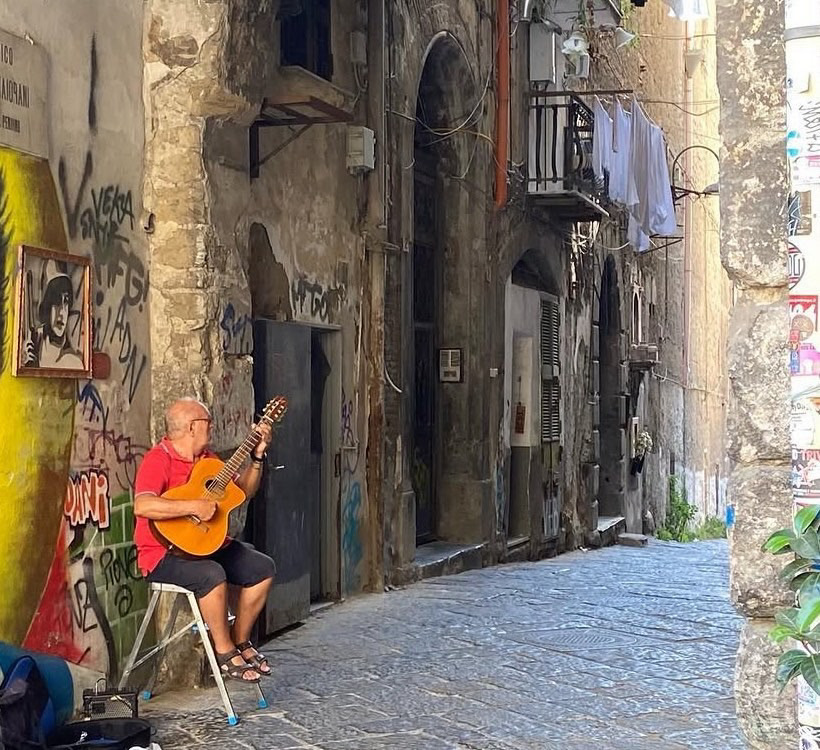
My favourite buskers remain those who give themselves completely to their instruments and their immediate audience. A man on Bold Street bangs a conga, a plosive, percussive backdrop which travels up and down the road, echoing the footsteps of passers-by on busy days. At the top of Hanover Street, a sat down and smiling, bearded accordionist plays often unheard harmonies better suited in France, giving a warm cosmopolitan soundscape that travels airborne. Amidst the busy shops of Liverpool One, four youngsters set up their instruments and play as though it was Glastonbury. A flautist in a London tube station echoes through endless corridors, winking kindly as you pass. A guitarist in the centre of Sheffield plays syncopated reggae stabs, dancing often with those who stand to watch, dreadlocks swaying at his knees. All of these have but pennies in their hats, which sit at their feet, and yet they smile and nod nonetheless. There is a laudable air of authenticity in busking, which the live stream takes away. In a rush, you hear it for but a second, but it is a second of refreshment rarely felt in a busy day. It echoes the commotion of life, the oscillation of people from one place to the next, almost mocking the hubbub and reminding us of life’s simple pleasures.
I’m sure that at the end of the day, that New York five-piece pack down their instruments with a grin, eager to return tomorrow. After all, how disappointing all this would be if it were merely silent.
written by Sam Horsfield
Leave a Reply